
Every week, founders tell me the same thing:
“We don’t have money for a CFO.”
And honestly? I get it. When you’re building a startup from the ground up, every rupee matters. Hiring someone full-time for the finance function feels like a luxury — not a necessity.
But here’s the problem. Those same founders still want clean books, investor-ready financials, zero compliance issues, and real-time visibility into their numbers.
That’s not bookkeeping. That’s a CFO.
In this blog, we’ll break down what actually happens when startups skip the CFO function — and what the smarter, more affordable path looks like.
Table of Contents
- The Gap Between What Founders Want and What They’re Paying For
- What Happens When You Skip the CFO Function
- The Hidden Cost of “Saving” on Finance
- What a Virtual CFO Actually Does for Your Startup
- Smart Finance Is Not an Expense — It’s a Shield
- Conclusion: You Don’t Have to Choose Between Growth and Financial Control
The Gap Between What Founders Want and What They’re Paying For
Most founders hire a basic accountant when they start. That’s completely normal. But as the business grows, the demands on the finance function grow too.
Here’s what founders actually need — but don’t realise they’re asking for:
- Real-time visibility into cash and profits
- Financials that can survive investor due diligence
- GST, TDS, and compliance handled end-to-end
- Unit economics that show which products actually make money
- Cash flow forecasting so you’re never caught off guard
A basic accountant handles data entry. A CFO handles decisions. These are two very different jobs — and mixing them up is where the trouble starts.
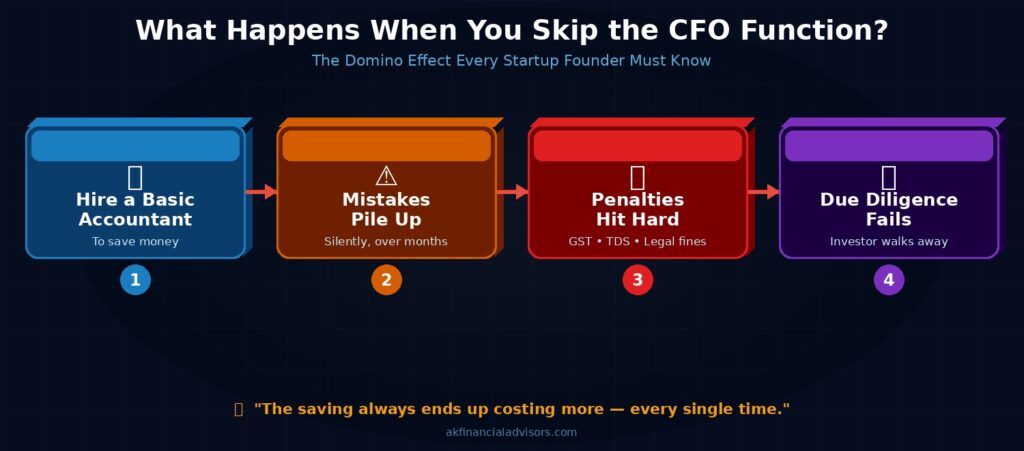
What Happens When You Skip the CFO Function
When a startup avoids investing in proper financial leadership, here is how it usually plays out:
Mistakes Pile Up Quietly
Small errors in bookkeeping, tax filings, and reconciliations don’t show up immediately. They compound over months. By the time you notice something is wrong, the damage is already done.
Penalties Hit Loud
GST notices, TDS defaults, and income tax penalties don’t arrive with a warning. They arrive with interest, fines, and sometimes legal exposure. Compliance penalties in India have tripled in the last decade.
Due Diligence Fails Even Louder
When an investor or acquirer wants to look under the hood of your business, messy books kill deals. It’s that simple. Investors don’t just look at traction — they look at financial hygiene.
You might have built a great product. But if your finances look unprofessional, they will walk away.
The Hidden Cost of “Saving” on Finance
Let’s be honest about what “saving” on a CFO actually costs you:
- One missed compliance filing
→ Penalties and notices that cost 3x–10x more than the filing itself
- One failed fundraise due to messy books
→ Months of delay and the opportunity cost of capital you didn’t raise
- One bad month of cash flow with no forecast
→ Payroll delays, vendor disputes, and loss of team morale
The “saving” always ends up costing more. Every single time.
What a Virtual CFO Actually Does for Your Startup
A Virtual CFO gives you CFO-level thinking — without the full-time salary. Here’s what that actually looks like in practice:
Real-Time MIS Reporting
Instead of waiting 30–60 days to know how your business performed last month, you get a clear financial dashboard within days. Decisions happen faster. Errors get caught sooner.
Investor-Ready Financials
Your books are always clean, structured, and ready for due diligence. Whether you’re raising a seed round or Series A, you walk into every conversation with confidence.
End-to-End Compliance Management
GST, TDS, income tax, ROC filings — all handled with 99% accuracy. No surprises. No notices. No panic.
Cash Flow Forecasting
Know exactly when your cash dips, when you need to collect faster, and when you have room to spend. Stop running your business on gut feel.
Unit Economics Clarity
Understand which product, service, or customer is actually profitable. Make smarter decisions about where to grow — and what to cut.
Smart Finance Is Not an Expense — It’s a Shield
Here’s the mindset shift that changes everything for founders who get it right:
Smart finance isn’t something you spend money on. It’s the investment that protects every other investment you make.
Your product, your team, your marketing — all of it can fall apart if the finance function breaks down. When you have proper financial oversight, you’re protected from penalties, fraud, poor decisions, and investor rejection.
A Virtual CFO isn’t a cost centre. It’s your financial immune system.
Conclusion: You Don’t Have to Choose Between Growth and Financial Control
The old excuse — “we can’t afford a CFO” — no longer holds. With a Virtual CFO model, you get:
- CFO-level strategy and oversight
- Clean books and full compliance
- Investor-ready financials at all times
- Real-time visibility into your numbers
- All without hiring a full-time finance head
You don’t have to choose between saving money today and protecting your business tomorrow. With the right financial partner, you can have both.
If you’re a founder navigating this — let’s talk.
About the Author: Akshit Khanna is a Chartered Accountant and Co-Founder of Stalwarts CFO LLP and AK Financial Advisors. He specialises in building investor-ready finance functions for startups and growing businesses across India.